


 Organic Baby Formula Original
 Follow-On Milk 6+
 Follow-on milk
 Organic Infant Formula from Whole Milk
 Follow-on Milk
 Organic Infant Formula from Goat's Milk
 Follow-On Milk
 Organic Bone Broth
 Beef
 For Moms
 Organic Energy Balls


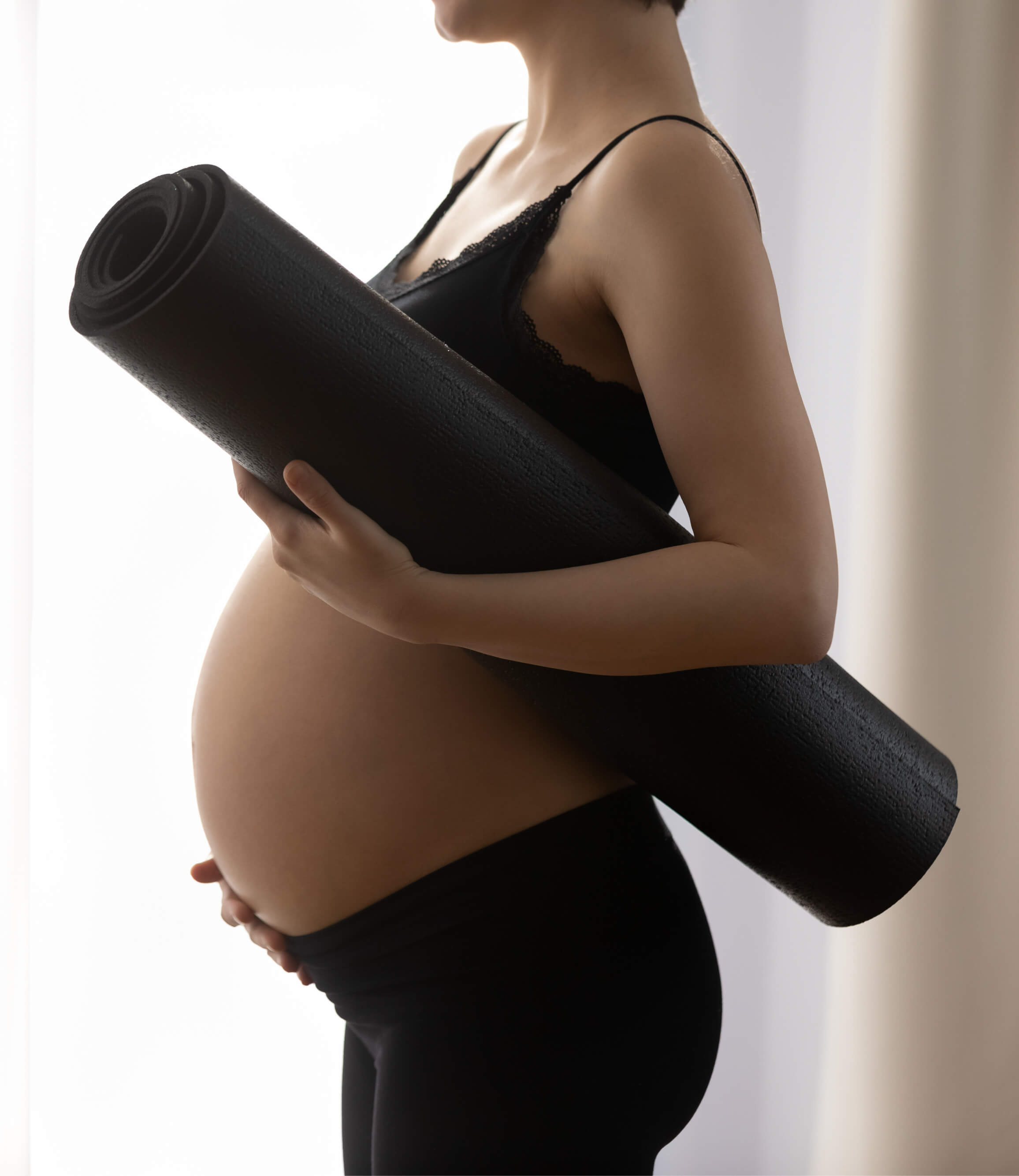
Pregnancy yoga really helps you
We are so happy for you: Congratulations on your pregnancy! Depending on how many weeks pregnant you are now, you may have already been able to feel changes in your body and also in your emotions. Prenatal yoga is one possible method to find and maintain your inner balance. Yoga during pregnancy reduces stress and also increases the strength and flexibility of the muscles that are important for childbirth.
Yoga is a mind-body practice that includes a system of body postures or seated positions (asana), deep breathing (pranayama), and meditation.
There are countless styles of yoga: Hatha yoga, Ashtanga yoga, Kundalini yoga, Jivamukti yoga, and so on. All these styles of yoga are wonderful, even during pregnancy, if you are already an experienced yogi. In that case, you can continue your usual yoga practice, including asanas, at a gentle level. If yoga is new to you: It’s great that you’re starting now. The best type of yoga for you is prenatal yoga. It will be worth it, because simply scheduling a regular appointment in your calendar and taking time just for yourself will benefit both you and your baby.
“Prenatal yoga helps women who suffer from anxiety, depression, stress, back pain, and sleep disorders during pregnancy.”
– Shilpa Babbar, MD, and Jaye Shyken, MD St. Louis University, St. Louis, Missouri
What is prenatal yoga?
Especially in prenatal yoga, yoga asanas are selected and arranged in a sequence that can be beneficial for pregnant women. For example, greater emphasis is placed on strengthening the back muscles and the pelvic area. Asanas that heavily engage the abdominal muscles, involve twists, or are practiced lying on the stomach are avoided. Basically, prenatal yoga is a gentle and slow yoga practice designed to reduce pregnancy discomfort and serves as a method for childbirth preparation.
What are the benefits of prenatal yoga?
Whether prenatal yoga is a useful method in general during pregnancy or specifically as preparation for childbirth has been investigated by researchers from various disciplines. The evidence for the benefits of yoga during pregnancy is increasingly growing: stress, anxiety, depression, pregnancy and labor pain, sleep deprivation, and other pregnancy-related ailments are demonstrably alleviated by regular yoga practice[7].
When can you start doing yoga during pregnancy?
For the first trimester, doctors generally recommend scaling back activities by one level and being more cautious in everyday life. If you are an experienced yogi, you can continue practicing yoga with a gentle routine. As a yoga beginner, it is better to wait until the second trimester before starting prenatal yoga. Regardless of how much experience you have with yoga, please speak personally with your doctor beforehand.
Which yoga exercises can I do during pregnancy?
A yoga practice that you can basically do anytime, even in the first trimester, is the yoga practice of meditation.
| Short meditation exercise:
Find a quiet corner in your home where you can be undisturbed for a moment. Set the timer on your phone for 3 minutes. Choose a comfortable seat, whether on a chair, the sofa, or the floor. You can leave your eyes half open or close them completely while meditating. Scan your body once from head to toe. Then focus your attention on your breathing and observe the airflow passing by the tip of your nose. When the timer goes off, you can slowly come out of the meditation. If you do this every day, you can gradually increase the time on the timer. |
From the second trimester onwards, you can start practicing yoga asanas that strengthen your back, pelvis, and hips. These include, for example, the chair pose (Utkatasana), the deep squat (Malasana), or the shoulder stand (Setu Bandha Sarvangasana).
A yoga sequence with nine yoga exercises for pregnant women follows in the next section.
9 Yoga Exercises for Pregnant Women
So, let's get a little more practical and practice yoga. If you feel like it, you can pick out and play a playlist while you move around on your yoga mat. In each of the asanas (2) through (8), stay for 10 breaths. In the meditation (1), also stay for 10 breaths, and in the final relaxation (9), you can stay for as long as you like.
1. Breath Meditation – to Arrive
Feel free to sit on a cushion or yoga block in a cross-legged position. Close your eyes and place the back of your right hand in your left palm, so that the right palm faces up. Inhale and count to four. Exhale and count to four. Repeat this exercise 10 times. Use your fingers to count the breaths.
2. Seated Side Stretch – to Open the Upper Body
Sit cross-legged with your left forearm resting in your lap. Inhale and stretch your right arm up. Exhale and lean to the left. Stay here for 5 breaths, then repeat the same exercise on the other side for 5 breaths.
3. Cat-Cow – for loosening the neck and shoulders
Get on all fours. Place your hands under your shoulders and your knees under your hips. As you inhale, begin to lower your spine vertebra by vertebra from the tailbone, until at the end of the inhalation you lift your head and look up. As you exhale, start rolling everything back up from the tailbone and bring your chin to your chest at the end of the exhalation to make your back as rounded as possible. Repeat the exercise 10 times.
4. Quadruped position with diagonal extension – to strengthen the back
In a tabletop position with a straight back, extend your right arm forward and your left leg backward, parallel to the floor. Hold this position for 5 breaths. Then do the same on the other side. Make sure not to arch your lower back.
5. Child’s pose with bolster (Balasana) – for resting
Bring your big toes together, widen your knees, draw your buttocks toward your heels, and rest the point between your eyebrows on the floor. Your belly lies between your legs. From the third trimester onward, place a yoga bolster or a pillow under your upper body and head to give your belly more room. – 10 breaths.
6. The Chair (Utkatasana) – Strength for the Legs & Back
Come to a stand and bring your feet hip-width apart, or even a little wider if you prefer. Bend your knees slightly, almost as if you were about to sit down on a chair. Stretch your arms shoulder-width apart above your head. Keep your arms straight all the way to your fingertips. – 10 breaths.
7. Deep Squat (Malasana) – to open the pelvic area
Bring your legs wider than your hips and squat down. If your heels lift off the floor, place yoga blocks or books under them. Bring your hands together in front of your chest and press your knees apart with the elbows of your arms. Keep your buttocks low, but your upper body as upright as possible. – 10 breaths.
8. Shoulder Bridge (Setu Bandha Sarvangasana) – to strengthen the pelvic and hip area
Lie on your back. Bend your knees slightly. Your feet are at least hip-width apart. With an inhale, lift your hips up and interlace your hands under your buttocks into a fist. Pull the fist toward your feet. – 10 breaths.
9. Deep Relaxation (Savasana) – A Letting-Go Exercise to Prepare for Labor
Lie completely flat on the floor. Feel free to cover yourself with a blanket and use an eye pillow or place a cloth over your eyes. Make yourself comfortable. Your legs and arms are stretched out to the sides, your toes and fingers are relaxed. Take one deep breath in through your nose and sigh the air out through your mouth. Your body is completely relaxed. Stay here for as long as it feels good, feel free to stay for 5 minutes or longer.
Are there any yoga poses I should avoid during pregnancy?
When doing yoga during pregnancy, you should pay attention to the following:
- No twists at belly button height
- Be careful when stretching!
- Avoid vigorous practice; practice gently instead
- No exercises lying on your stomach
- No abdominal exercises; breathing should be calm and steady
Conclusion: Yoga is a well-deserved break for you
There is no doubt that yoga will do you good during your pregnancy, provided your doctor does not advise against it. Numerous studies show that regular yoga practice can help alleviate pregnancy-related discomfort and ease childbirth. And even if you have doubts about the benefits of yoga, it is a wonderful break from everyday stress that is all your own.

Read on ...
In addition to a yoga practice, we have more tips for your pregnancy.
Note on the 9 yoga exercises
The nine prenatal yoga exercises in this article are suitable for pregnant women from the second trimester onwards, have not been scientifically reviewed, and do not constitute a health claim. The yoga sequence was created by an advanced yoga teacher. Feel free to supplement this with a regular prenatal yoga class at a studio or online.
A comment on the article
As positive as the research sounds, it remains unclear which yoga poses should be repeated how often to achieve a certain level of pain relief. There is no doubt that a regular yoga practice can be beneficial for overall life satisfaction. Perhaps yoga is also a practice that does not need to be quantified to know that it can be beneficial.
Selection of current studies on the benefits of prenatal yoga:
- Reduces labor pain and enables a more comfortable birth[1]
- Helps with prenatal depression[2]
- Stress-reducing effect (also in high-risk pregnancies)[3+4]
- Reduction of pregnancy complications associated with high blood pressure[5]
- Has a positive effect on blood sugar levels in pregnant women with gestational diabetes mellitus (GDM)[6]
- Reduces lower back pain[7]
- Improves breathing and can thus help during delivery[8]
Scientific Papers:
[2]Potential for prenatal yoga to serve as an intervention to treat depression during pregnancy
[3]Yoga for high-risk pregnancy: a randomized controlled trial
[4]Immediate stress reduction effects of yoga during pregnancy: One group pre-post test
Additional sources:
- Way-Yoga: https://www.way-yoga.de/way-yoga-blog-full/335-neue-studie-prae-und-postnatales-yoga-nicht-nur-gut-fuer-sie-sondern-auch-fuer-ihr-kind.html
- Thieme: https://www.thieme.de/de/hebammenarbeit/yogatherapie-in-der-schwangerschaft-156871.htm
- Yogaeasy: https://www.yogaeasy.de/artikel/mamaste-die-besten-asanas-werdende-mamas
Related Articles

Pregnant – what now?! Embarking on a new chapter of life.

8 Common Pregnancy Complaints and How to Deal with Them
Pregnancy is magical, isn't it? Not really.
12 things no one told you before about postpartum
The magical, exhausting and simply unique time in the postpartum period is so incredibly important and unfortunately can often be neglected.


