


 Organic Baby Formula Original
 Follow-On Milk 6+
 Follow-on milk
 Organic Infant Formula from Whole Milk
 Follow-on Milk
 Organic Infant Formula from Goat's Milk
 Follow-On Milk
 Organic Bone Broth
 Beef
 For Moms
 Organic Energy Balls
 for nursing mothers


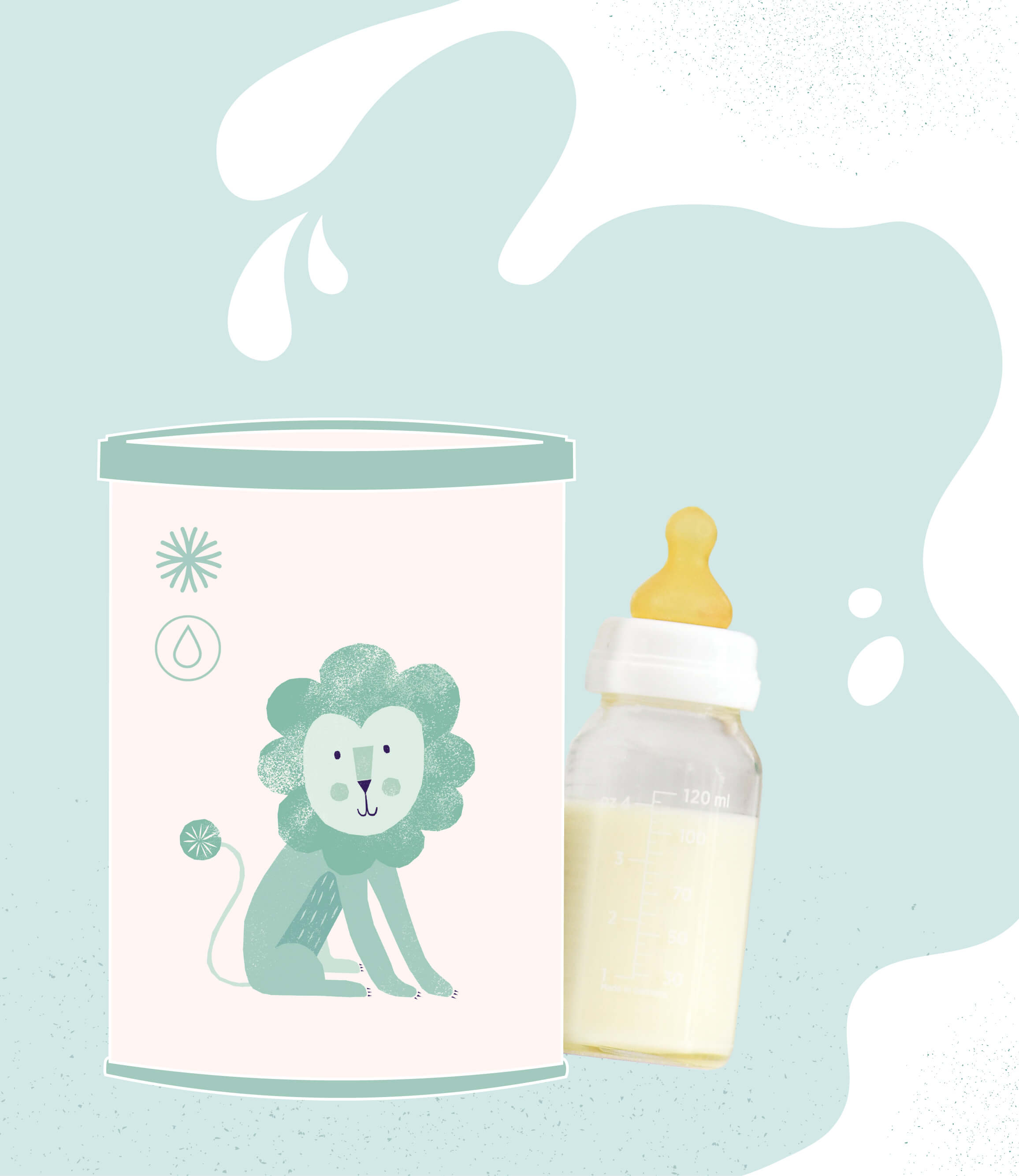
Drawing from the best: Milk formula from whole milk
Finally available on the German market: infant formula made from whole milk. Our Löwenzahn Organics family has grown, so we can offer babies and parents a wider selection. Our product team, made up of nutrition scientists specializing in baby food, spent over two years working on the recipe for infant formula made from whole milk powder. We are convinced of our organic product made from whole milk powder. And not only because whole milk powder has already proven itself in infant formula in other European countries. We have added only organic ingredients to our own whole milk powder recipe, without fish oil, without palm oil, and without genetic engineering.
You might already have your first questions: How? Is there really a baby formula based on skimmed milk and whole milk powder? What are the differences? Or what makes Löwenzahn Organcis whole milk powder follow-on milk so special? Which organic ingredients are included in the new recipe? And does the whole milk follow-on milk contain more calories? We want to tell you all about it in this blog post.
Table of Contents
How it all began
A brief digression
What is the difference?
Does whole milk contain more calories?
Our baby milk made from whole milk powder
Valuable ingredients
That's why it's 100% recyclable
In summary
How it all began: Why a new baby formula recipe based on whole milk?
Our co-founder Liz had a burning desire to create a follow-on milk that would address the needs of our little ones even more effectively than anything else available on the market. Liz challenged our team of nutrition scientists to develop a milk formula without palm oil, taking into account the latest scientific findings on fats and other nutrients in breast milk.
Our experts enthusiastically took on this challenge. When developing the new formula, they also considered every aspect of the manufacturing process to minimize the risk of mineral oil contamination from ingredients or packaging.
Where does our ambition come from? Löwenzahn Organics baby and maternal food in organic quality is designed for the first 1,000 days. After all, a human life is never as malleable as it is from conception until the second birthday.

Brief digression: What is actually in powdered milk?
Follow-on milk is a food that is processed to varying degrees, either highly or less so. It is usually available in powder form, which can be mixed with boiled water at home and prepared as a complete meal for babies.
The milk powder is made from cow's milk or goat's milk and further processed into skimmed milk powder or whole milk powder. To obtain a finished milk powder, essentially a carbohydrate source, long-chain, unsaturated fatty acids, as well as other macro- and micronutrients are added. The respective formulations differ in quality between manufacturers.
WHO note: Breastfeeding is the best nutrition for your baby. The composition of breast milk always offers your baby the ideal combination of nutrients and good protection against allergies and diseases. The WHO therefore recommends exclusive breastfeeding for 6 months and continuing to breastfeed after that in conjunction with age-appropriate and balanced complementary food. Consult healthcare professionals (e.g., pediatrician, mother/father counseling service, midwife, lactation consultant) if your child needs supplementary food or if you cannot (sufficiently) breastfeed. The use of infant formula can affect breastfeeding success. The decision not to breastfeed can be difficult to reverse.
What is the general difference between follow-on milk formula made from whole milk and follow-on milk formula made from skimmed milk?
Follow-on milk made from whole milk powder has a major advantage over follow-on milk made from skimmed milk powder. This is because it still contains all the natural fats of the milk and therefore requires significantly fewer processing steps.
However, in Germany, it is customary to produce follow-onmilk from skimmed milk powder, as this is suitable from a nutritional science point of view and more cost-effective. However, palm oil or coconut oil and other vegetable oils are added to follow-on milk made from skimmed milk powder to replace the milk's natural fats. And here we come to the first “but”. What if you would like to have follow-on milk that is less highly processed, thus exposed to an even lower risk of contaminants, and contains no palm oil or other tropical oils?
Does follow-on milk made from whole milk powder have more calories than that made from skimmed milk powder?
Let me be clear from the outset: NO. Fats are very important in follow-on formula because babies need fats for energy and their development. Followon formula based on skimmed milk powder simply has more fat added than followon formula made from whole milk powder. This is why both end up having the same number of calories.
What makes our follow-on milk formula made from whole milk powder so special?
The new Löwenzahn Organics whole milk formula is, like all our organic products, tailored to the needs of babies. The new follow-on milk formula has some premium benefits in particular.
Our follow-on milk formula is made from whole cow's milk powder, which has a fatty acid composition very similar to breast milk and therefore requires less processing. It contains no palm oil or other tropical oils.
Its premium benefits also include the fact that we have added new ingredients based on current scientific studies: it contains nucleotides and taurine. In addition, the whole milk follow-on formula contains no starch, but only organic lactose as a carbohydrate source. Our whole milk follow-on formula also contains 3'-GL (HMO 3'-GL occurs naturally in breast milk).
Let's go into a little more detail about our follow-on milk formula. If that is too much for you, from now on you can just read the headings and the summary at the end to get an overview of the new whole milk formula:
Nucleotides are building blocks of DNA and are important during growth phases
From a biological perspective, the foundation of our existence is our DNA. It not only determines our appearance, such as whether we have blue eyes or not, but is also extremely important in all possible processes in our body. Whether in the development of our immune system or the development of the gastrointestinal system: DNA has its fingerprints on it.
And what about DNA itself? Just as DNA makes up the building blocks of our body, nucleotides make up DNA. In infancy, we are in the greatest growth phase of our lives. During this phase, babies need a particularly large number of nucleotides for the construction of DNA.
Where does our body get nucleotides from? The important nucleotides can be produced by the body itself and taken in through food. Unfortunately, in infancy, not enough nucleotides can be produced by the body itself. Breast milk is a source of free, i.e., unbound nucleotides. Alternatively, free nucleotides are also contained in animal milk. Furthermore, nucleotides can be specifically added to milk formula.
Taurine is important for fat absorption
Taurine is an amino acid found in high concentrations in breast milk. Taurine is important for fat absorption. Okay, stop—and what is an amino acid?
Amino acids are the basic building blocks of proteins, which are involved in almost all biological processes in our bodies. Muscles, cells, and tissues are all largely composed of amino acids.
Back to taurine. It is found in high concentrations in breast milk. However, cow's milk contains no taurine. The human body can produce taurine itself, but not during infancy.
3’-GLs are part of HMOs
Scientific advances are leading to an increasingly detailed understanding of the components of breast milk. In addition to lactose and fats, the third largest component of breast milk is human milk oligosaccharides (HMOs). HMOs are carbohydrates that occur naturally exclusively in breast milk. Our follow-on whole milk formula contains the HMO 3’-GL.
The positive effects of 3’-GL include: anti-inflammatory properties, support for the development of a healthy gut, and promotion of immune system development.
Without starch – lactose also provides energy in our whole milk follow-on milk
Starch is a valuable source of energy and may be contained in follow-on milk – but starch is not essential. Why did we not add any starch to our follow-on milk made from whole milk powder? Well, breast milk also contains no starch. All our pre-follow-on milks also contain no starch. This is one of the reasons why many parents do not want to switch to follow-on milk. For parents who want to avoid starch but still want to switch to a follow-on milk rich in iron, calcium and iodine, a starch-free follow-on milk is therefore a good option.
Valuable ingredients in all our follow-on milk formulas
Of course, our follow-on milk formula made from whole milk powder also contains all the valuable nutrients found in our Original Follow-on Milk and goat milk-based follow-on milk:
- Organic certified
- Omega-3 fatty acid (DHA) and omega-6 fatty acid (ARA) in a 1:1 ratio,
- DHA from algae oil instead of fish oil, among other reasons because algae oil tastes better
That is why the new packaging is 100% recyclable
Another advantage of our milk formula made from whole milk powder is that it is even more sustainable than our previous milk formula. This is because we have been able to completely replace the packaging. Instead of the multi-layer film usually used and suitable for infant formula, we package our milk formula entirely in a tinplate can.
Tinplate cans are made from a single material and are therefore 100% recyclable. The plastic scoop in the can is also made from a single material and is therefore equally recyclable.
Summarized in a nutshell
Our follow-on milk formula made from whole milk contains all the natural, milk-specific fats and therefore requires fewer processing steps compared to baby milk made from skimmed milk powder. Because the natural, milk-specific fats are preserved in whole milk powder, this follow-on milk formula requires less processing and no palm oil needs to be added.
We also took the opportunity to add nutrients to the new follow-on milk formula that are beneficial for babies according to current scientific findings. These include nucleotides and taurine:
- Taurine is important for fat absorption. Nucleotides are building blocks of DNA and are important during growth phases.
- In follow-on milk: 3’-GL. These are also a component of HMOs.
- In follow-on milk: Follow-on milk without starch—because starch is not essential and is also not found in breast milk.
Would you like to know more?
Anne Fechner, product developer at Löwenzahn Organics and expert in the field of milk-based nutrition, answers frequently asked questions.

Does follow-on milk made from whole milk contain more fat than follow-on milk made from skimmed milk?
Anne: No. Follow-on milk made from skimmed milk powder contains as much fat as milk formula made from whole milk powder. The natural milk fat has been removed from skimmed milk powder, and vegetable oils are added to follow-on milk made from skimmed milk powder as a replacement.
Why don't other German manufacturers produce follow-on milk made from whole milk?
Anne: Whole milk still contains valuable milk fats, which means it is significantly less highly processed. However, milk fat is very expensive, which is why most manufacturers use the cheaper skimmed milk instead.
How do I switch from one milk formula to another?
Anne: If your baby does not tolerate their current milk formula, you can switch to a new one immediately. However, if your baby tolerates their current milk formula well, you can finish the current pack before switching to the new pack or gradually introducing the new formula. Learn more about switching follow-on milk.
How important is taurine in milk formula?
Anne: Taurine is an amino acid that helps your baby's body better process the important fats in the follow-on milk. Taurine is included in our follow-on milk made from whole milk.
Does baby milk made from whole milk powder taste and smell different from that made from skimmed milk powder?
Anne: There is a difference in taste: Our follow-on milk made from whole milk tastes and smells slightly creamier. A general advantage of all our milk formulas is that they do not have a fishy smell, as they contain algae oil as a source of DHA.
Read on ...
Have you become a bit of a nerd when it comes to baby formula? Here you'll find useful information about our baby formula comparison.
Sources
R W Chesney et. al. The role of taurine in infant nutrition. Advances in Experimental Medicine and Biology
Hess, J.R., Greenberg, N.A., The Role of nucleotides in the immune and gastrointestinal systems potential clinical applications. Nutrition in Clinical Practice. 2012;27(2):281-94
Eckhard Schlimme, D. Martin and H. Meisel Nucleosides and nucleotides: natural bioactive substances in milk and colostrum. British Journal of Nutrition. 2000;84(S1):59-69
Related Articles

Our baby milk is the test winner at Stiftung Warentest
We are test winners at Stiftung Warentest: Our "Pre" First infant Formula based on cow's milk (skimmed milk powder) received the best rating.

So that baby's tummy doesn't play up: goat milk for your baby
Our Löwenzahn Organics family has grown to meet the needs of babies and parents even better.

Changing baby milk – how, when, why?
When do you switch from initial "pre" milk to follow-on formula, i.e. to the next level? Or what do you do if your baby doesn't tolerate the current baby formula well and would like to switch?


