


 Organic Baby Formula Original
 Follow-On Milk 6+
 Follow-on milk
 Organic Infant Formula from Whole Milk
 Follow-on Milk
 Organic Infant Formula from Goat's Milk
 Follow-On Milk
 Organic Bone Broth
 Beef
 For Moms
 Organic Energy Balls


Nutrition Plan for the First Year of Life
Babys erstes Lebensjahr ist eine unglaublich aufregende Zeit mit vielen emotionalen Ups und Downs. Es passieren so viele gemeinsame erste Male, dass du schon ein Buch darüber schreiben könntest. Klar ergeben sich dir damit auch unzählige Fragen. Eine ganz Wichtige ist die nach einer kindergerechten Ernährung im ersten Lebensjahr. Wir haben für dich zusammengefasst, worauf du bei Babynahrung achten kannst und in welchen Schritten du von der reinen Stillzeit und oder Fütterung mit Folge-Milchnahrung in die Beikostzeit kommst. Wann kannst du deinem Baby Wasser geben und auf welche Lebensmittel solltet ihr im ersten Lebensjahr am besten verzichten. Auf noch ganz viele wunderbare erste Mall mit deinem Baby. Weiter geht es mit einem Ernährungsplan für dein Baby für das erste Lebensjahr.
Table of Contents:
- What should you look for in baby food?
- From birth: Breastfeeding and bottle feeding
- From 5 months: Starting solids with lunch porridge
- From 6 months: Evening porridge
- From 7 months: Afternoon porridge
- From 10 months: From solids to family meals
- Fluid intake in the first year of life
- Foods unsuitable for babies in their first year of life
- Excursion: Family meals from 12 months
- Where to order organic baby food?
What should you look for in baby food?
Baby food is specially formulated food designed to meet your baby's special nutritional needs. In addition to natural breast milk, there is also industrially produced baby food. This includes infant formula and follow-on formula. These are subject to the strict requirements of EU Regulation (EU) 2016/127 on infant formula. Differences, such as in the list of ingredients, depend on the manufacturers.
Complementary food products such as baby food or pureed fruit and vegetables are also considered baby food and differ in their list of ingredients between manufacturers. A breast-free alternative to introducing complementary food is the baby-led weaning method.
|
Squeezies are low-fiber sugar traps: Fruit and vegetable squeezies lack fiber, fruit squeezies in particular have a high sugar content, and the production of single-use squeezies generates an unnecessary amount of waste. Why babies don't need sugar. |
Another important point with baby food: In addition to the recipe, organic is particularly important. This is because babies and toddlers are in a sensitive growth phase and can therefore be more sensitive to harmful substances.
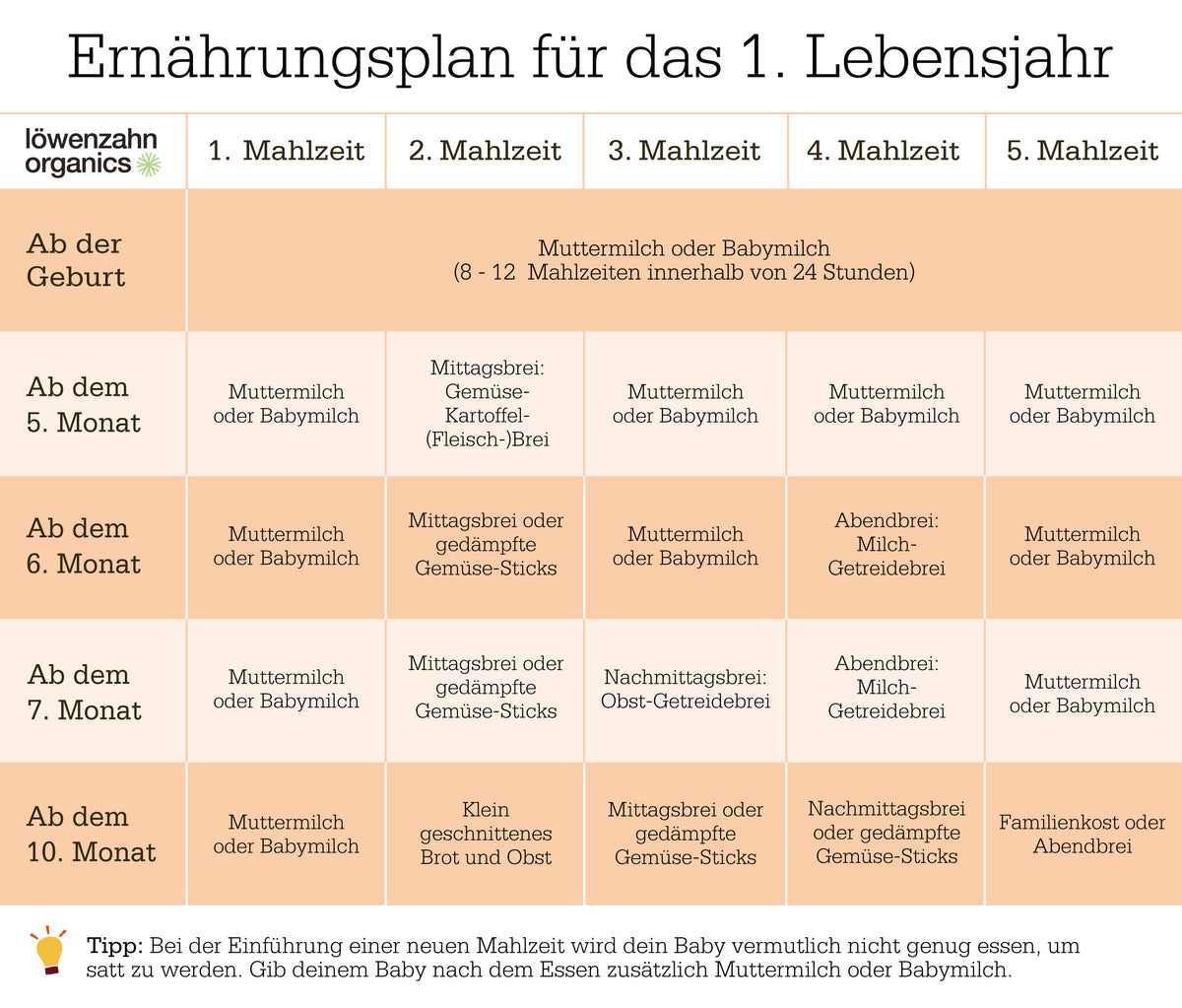
Here you can download the nutrition plan for your baby.
From birth: Breastfeeding and bottle-feeding
Breast milk is the best nutrition for your baby during the first six months. How long you and your baby want to continue breastfeeding is entirely up to you. But what if your wish to breastfeed does not come true? It is possible that you do not produce enough milk or that there are other obstacles in your life that make breastfeeding impossible.
The frequency and duration of breastfeeding or bottle-feeding depend entirely on your baby's needs. During the first six months, your baby does not need any additional fluids besides breast milk or baby formula.
Feeding plan from birth:
In the first few months, babies have an average of 8 feeds. You can calculate the amount for each bottle as follows: Take 1/6 of your baby's body weight and then divide it by the number of feeds. Et voilà: You now have the amount per feed. More information on calculating how much your baby should drink.
From the 5th month: Starting solids with lunchtime porridge
Breast milk is usually no longer sufficient to meet your baby's increasing need for energy and nutrients from a certain age. Good to know: The introduction of complementary foods is recommended by the German Federal Centre for Nutrition no earlier than the beginning of the 5th month and no later than the beginning of the 7th month.
However, every baby is different. So don't worry if your baby wants to start with baby food later. It is also perfectly fine if you decide on the Baby-Led Weaning method from the 6th month or if you want to choose a combination of complementary foods and Baby-Led Weaning.
With the classic start of complementary foods, it begins with the lunch puree, which at the beginning consists of only one type of vegetable. Pureed parsnips, potatoes, sweet potatoes, or carrots are wonderful as vegetables for your baby's first puree. With the introduction of complementary foods, the amount of puree is no larger than an ice cube. As your baby grows, they will be able to eat more puree per meal step by step. Observe your baby's reaction, because they will let you know when they are full.
If the vegetable is well accepted, meat will be added to the vegetable-potato puree in the following one to two weeks. As a vegetarian alternative, cereal flakes are very suitable. It is important to make sure that it is whole grain cereal.
Meal plan from the 5th month:
Five equal-sized meals.
- Breast milk or baby formula
- Introduction of midday porridge: vegetable-potato-meat/cereal porridge
- Breast milk or baby formula
- Breast milk or baby formula
- Breast milk or baby formula

From the 6th month: Evening porridge is the second step in the weaning process
The second step in introducing solid foods is baby’s evening meal. An evening meal is a milk-and-cereal porridge. Since birth, your baby has probably grown by about 20 centimetres and needs even more energy than before. You can start offering an evening meal from the 6th month up to the 8th month.
After the sixth month, you can also offer your baby water in addition to breast milk or infant formula. Instead of tap water, it is better to give your baby boiled water that has been allowed to cool to room temperature.
|
Baby-led weaning info box: From the age of 6 months, you can start replacing one milk feeding with a steamed or pre-cooked vegetable stick. The stick should be approximately the size of one of your little fingers. In terms of consistency, the stick should be soft enough that it doesn't bounce off the plate when your baby tries to grab it. |
Feeding plan from the 6th month:
Five equal-sized meals.
- Breast milk or baby formula
- Lunch porridge or vegetable sticks + additional breast milk or baby formula as needed
- Breast milk or baby formula
- Evening porridge: milk-cereal porridge
- Breast milk or baby formula
From the 7th month: Afternoon porridge as the third step in introducing solids
The afternoon porridge or cereal-fruit porridge is suitable for babies from 7 months onwards, or at any later stage. Many parents choose a time between 3 and 5 p.m. The exact time depends entirely on your routine and when your baby gets hungry.
Feeding plan from the 7th month:
Five meals of equal size.
- Breast milk or baby formula
- Vegetable sticks or lunch porridge: Vegetable-potato-meat/cereal porridge
- Afternoon porridge: Cereal-fruit porridge
- Evening porridge: Milk-cereal porridge
- Breast milk or baby formula

Tip: From the 8th month, use Organic Baby Bone Broth to season vegetable or meat purées. Bone broth is also ideal as a source of nutrients when your baby has reached the pasta-only phase. Here you will find bone broth recipe ideas.
From the 10th Month: From Complementary Foods to Family Meals
From around 10 months of age, babies can be gradually introduced to family meals. You can continue to offer your baby vegetable sticks and also observe which meal your baby reaches for at the dining table and what they would like to try.
Even if your baby only has a few teeth at this time, they are able to crush solid foods with their jaw. It is therefore no longer necessary to puree food finely. But of course, this depends on your baby. Every baby is different and starts with solid food earlier or a little later.
One idea to move away from pure milk meals to breakfast is to offer breast milk or baby formula from a cup and to serve small pieces of soft bread with it. Here you can learn more about the topic Learning to drink.
Meal plan from the 10th month:
Three main meals and two snacks.
- Breast milk or baby formula
- Finely cut bread and fruit
- Vegetable sticks or midday porridge: vegetable-potato-meat/cereal porridge
- Finely cut bread and fruit or afternoon porridge: cereal-fruit porridge
- Evening meal at the family table or evening porridge

Fluid intake in the first year of life summarized
For the first 6 months, exclusively breast milk or infant formula.
- Fluid intake: After the sixth month, in addition to breast milk or infant formula, you can also offer your baby boiled water.
- Drinking vessels: From the sixth month, babies can drink from a cup or a mug with a straw. It is advisable to move away from the bottle in the first year of life to promote the healthy development of oral motor skills.
- Pay attention to thirst cues: Pay attention to your baby's thirst cues. If they are restless, crying, or still seem hungry after a meal, they may be thirsty.
- Hot weather and illnesses: In hot weather or if the baby suffers from illnesses such as fever or diarrhea, their fluid requirements will increase.
Unsuitable foods for babies in their first year of life
Foods that your baby should preferably not eat yet are the following:
- Honey: Babies under one year of age should not be given honey, as it can contain the bacterium Clostridium botulinum, which can cause a serious illness (botulism) in infants.
- Fish with high mercury content: Fish species such as swordfish or king mackerel contain high levels of mercury, which can be harmful to babies.
- Salt and sugar: Babies do not need any additional salt or sugar in their diet during their first year of life. Too much salt can strain the kidneys, and sugar can lead to cavities and overweight in kindergarten. It is best to use fresh fruit and vegetables for baby food.
- Caffeine: Caffeine should be strictly avoided during a baby's first year of life. Caffeine is a stimulant that is found in various drinks and foods such as coffee, tea, energy drinks, chocolate, and some soft drinks.
Excursion: Family food from the 12th month
After your baby has completed their first year, they are already a toddler and you can significantly expand their menu. Nevertheless, your child is still in a sensitive growth phase. Here you will learn more about the importance of the first 1,000 days in your baby's life.
Where to order organic baby food?
In the Löwenzahn Organics online shop, you can order organic follow-on milk formula and organic bone broth for babies online.
Sources:
- https://www.kindergesundheit-info.de/themen/ernaehrung/0-12-monate/saeuglingsernaehrung/
- Recommendations for infant feeding (brochure). Published by: Research Institute for Child Nutrition Dortmund 2015, 1st edition 2019
- Höfler E., Sprengart, P. (2018). Practical Dietetics. Fundamentals, Goals and Implementation of Nutritional Therapy (2nd edition). Wissenschaftliche Verlagsgesellschaft mbH
Related Articles

Sugar and babies: How much sugar is in a squeeze pouch?
100 ml of fruit puree pouch contains more sugar than 100 ml of Coca Cola. So why should fruit puree from drinking pouches be healthy?

Your Baby's First Evening Porridge
When do you start with the evening porridge? At what time? Which type of grain and which liquid are best to use?

Making Baby Food at Home: Cereal Recipe Ideas with Fruit and Vegetables
Baby food also tastes delicious with seasonal vegetables. Take 5 to 15 minutes to conjure up a cereal porridge or oatmeal for your baby.


