


 Organic Baby Formula Original
 Follow-On Milk 6+
 Follow-on milk
 Organic Infant Formula from Whole Milk
 Follow-on Milk
 Organic Infant Formula from Goat's Milk
 Follow-On Milk
 Organic Bone Broth
 Beef
 For Moms
 Organic Energy Balls
 for nursing mothers


Tick-tock... have the first 1000 days already begun?
The First 1,000 Days: Never again in your baby’s life will so much happen so quickly. A single egg cell develops into a child who can hop around the room and form complete sentences of varying lengths. How can you support healthy development during this time? The clock is ticking… Now is your chance to make a difference for your baby: taste preferences, risk of obesity, learning abilities, memory skills, and more are significantly influenced from pregnancy through your child’s second birthday. We want to explain to you why the first 1,000 days are so important. That’s exactly why we at Löwenzahn Organics develop products for this crucial time for moms and babies.
What are the first 1,000 days?
Let's start from the very beginning. The first 1,000 days begin with conception and end on the second birthday. 270 days are counted for the period of pregnancy and 365 days twice for the first two years of life: that makes 1,000 days.
That this period is of such fundamental importance has been highlighted by the doctor Berthold Koletzko, head of the Department of Metabolism and Nutrition at the University of Munich, among other scientists. He has intensively studied the “theory of the first 1,000 days,” that is, the effects of early childhood nutrition on later health, and uses the terminology metabolic programming.
What doctor Berthold Koletzko means by metabolic programming, medical doctor and TV doctor Matthias Riedl more or less calls early childhood conditioning. This is how poor dietary habits in early childhood or during pregnancy can lead to, for example, the development of taste and thus also the health being left to the sugar-laden food industry.
“Overweight and obesity have become a global pandemic in children and adults, with serious consequences for health, life chances, and also societal costs. Our work has shown that nutrition and growth in the first two years of life strongly shape later risk.” – Berthold Koletzko
What can be influenced in the first 1,000 days?
In short: The development of the brain, gut, immune system – simply everything a child still needs to develop. This also means that the development of allergies or skin conditions such as eczema, as well as weight gain, which is also closely linked to the development of taste preferences, can be influenced by the mother’s and baby’s diet during the first 1,000 days. In addition, genes can be switched on or off through targeted nutrition during the first 1,000 days, which in turn can affect learning and memory abilities.
“During the first thousand days, people are more malleable than at any other time in their lives.”
- Dr. med. Matthias Riedl.
Of course you want to give your baby the best possible start in life. If you are still pregnant, a full-value, pregnancy-specific diet is recommended now. And beware: you need significantly more nutrients now, but not twice the amount of food.
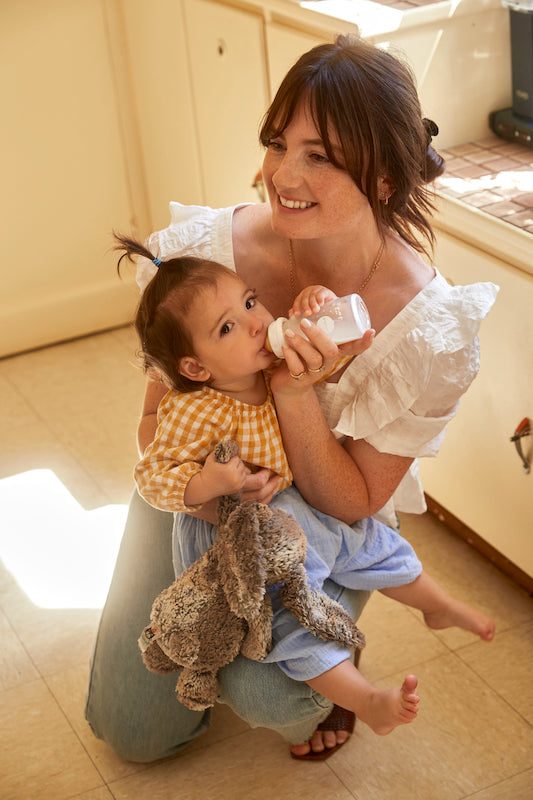
Breast milk is without a doubt the best for your baby. Tailored to your baby's age, your breast milk adapts to your baby's needs. But what if breastfeeding doesn't work? Then it is particularly important to pay attention to the ingredients list of baby milk. So, to whether all important nutrients have been added.
Even if your baby is already busily crawling or running around your home, you still have time to shape their habits regarding healthy eating and development. The window of the first 1,000 days lasts until their second birthday.
During the weaning period, it pays to check the packaging. Some baby food manufacturers use sugar and salt in their products.
And after the weaning period, that is after the first year of life, children no longer need special meals. Nevertheless, the family table plays a major role in shaping children's tastes.

Note: Even if your child is already older, you can still "reprogram" or “retrain” them. It’s just more effort.
How does a baby’s taste develop?
Prenatal
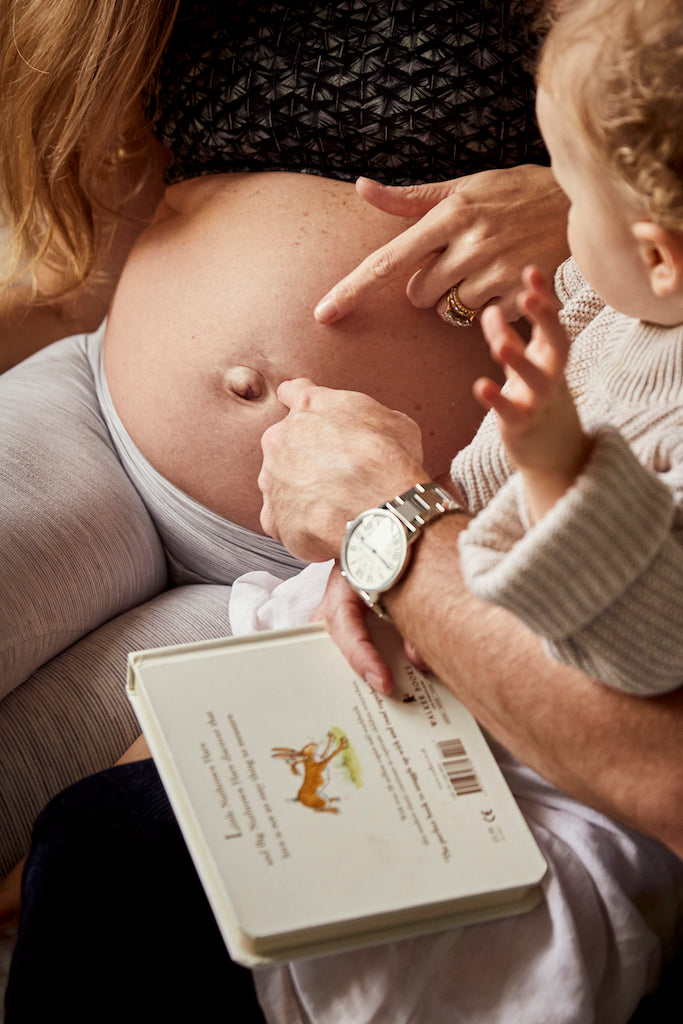
Did you know that you can influence your baby's taste buds even before birth? This happens through the amniotic fluid. Starting from the 4th month of pregnancy, a baby drinks 200 milliliters of it every day. And the taste of the amniotic fluid changes depending on what the pregnant woman eats. This means a baby can develop genetically determined taste preferences in the womb and experience the tastes of "sweet", "sour", "bitter", "salty" and "umami" (savory). Fun fact: During pregnancy, you can influence what your baby prefers to eat after birth. This is because babies prefer the flavors they already experienced in their mother's womb.
Innate preference for sweetness
After birth, babies are accustomed to the sweet taste of breast milk. Sweet foods are high in energy, and there are virtually no naturally sweet-tasting foods that are toxic. But babies can taste more than just sweetness; depending on the mother's diet, they also experience various flavors through breast milk.
Evolutionary conditioning
After birth, babies develop preferences for certain tastes depending on what they have been repeatedly offered. It is precisely the “eat what you know” approach. This principle is linked to an evolutionary safety mechanism designed to protect against consuming toxic foods (the “mere-exposure effect”). Another safety mechanism protects against nutrient deficiencies. Repeated exposure to the same taste leads to increasing satiety or aversion (known as “specific sensory satiety”). Together, these two evolutionary principles optimize both safety (mere-exposure effect) and dietary variety (specific sensory satiety) when choosing food.
When do babies develop a sense of taste?
A newborn baby can initially taste the flavors “sweet,” “sour,” and “bitter,” with “sweet” being its favorite. By four months, it can also taste “salty” and “umami.” At the latest after the 5th month, with the introduction of complementary foods, texture and especially the different smell are added to the taste.
Innate hunger and innate satiety
Every baby is born with an innate sense of hunger, thirst, and satiety. When hungry, it seeks its mother’s breast or a bottle and stops drinking when it is full. The disconnect from this perfect innate mechanism of thirst, hunger, and satiety only comes later. This happens when “eating when you are hungry” is replaced by “eating at externally determined mealtimes,” or when you have to finish everything on your plate, or when the size of the package determines how much you eat. Later, psychological and social factors also come into play, which can lead to our diets being shaped by the sugar-laden food industry.
Learning Processes: How You Can Influence Healthy Development/Formation
Babies at the family table see what Mom, Dad, their siblings, or even their grandparents put on their plates. All these people are role models and hey, why wouldn't what is good for them also be good for you? Babies learn by observing.
In parenting, many parents repeatedly use food to soothe their children. This is dangerous because it can lead to disordered eating. Food and emotions become linked. As a result, children lose the ability to distinguish between feelings and hunger. Let's summarize a few tips for you.
Tips for Parents
- Do not link food and emotions: Do not use food as a reward, bribe, or comfort
- Check the packaging: Ideally, children are fed according to their needs. That is, with breast milk and/or formula, followed by solid foods.
- Bring variety to the table: Offer your baby a variety of foods ("mere-exposure effect") and do not show any aversion to certain "healthy" foods yourself. Children do not need sugar. Every day without sugar is a win.
- Create mealtime rituals: Share meals at the family table, ideally with home-cooked food, so you know exactly what is in it.
- Prevent aversion to healthy food: Promote healthy food as normal, not as "healthy". When children are pressured to eat "healthy", they are more likely to react with aversion.
- Treat sweets as an occasional treat: Sweets are part of life, but not everyday life.
Read on ...
Baby formula test winner according to Stiftung Warentest.
Sources
Süddeutsche Zeitung:
https://www.sueddeutsche.de/leben/ernaehrung-kinder-essen-gesundheit-1.4742442?reduced=true
Scientific Articles:
https://link.springer.com/article/10.1007/s00103-010-1079-y https://link.springer.com/article/10.1007/s00112-009-2158-8 https://www.sciencedirect.com/science/article/abs/pii/S0195666312001092 https://www.doctors.today/a/praegung-praeferenzen-und-beeinflussung-1584234
Klinikum München:
Books:
Matthias Riedl: The Power of the First 1000 Days: Uncover Unhealthy Dietary Patterns from Early Childhood and Finally Escape the Conditioning Trap (Appropriate Nutrition), 2020
Sascha Inderbitzin and von Ulrike Blarer: The First 1000 Days for Mom, Dad, and Baby: Nutrition During Pregnancy and the First Two Years of Babyhood with the Best Gluten- and Dairy-Free Recipes, 2021
Related Articles

Our baby milk is the test winner at Stiftung Warentest
We are test winners at Stiftung Warentest: Our "Pre" First infant Formula based on cow's milk (skimmed milk powder) received the best rating.

Baby's intestines and its wondrous inhabitants: the intestinal flora
The intestine has its own universe full of bacteria, fungi and yeast. In the large intestine they form the intestinal flora and also communicate with the brain.

Introducing complementary food: when does it start?
Introduction to complementary food simply explained.


