


 Organic Baby Formula Original
 Follow-On Milk 6+
 Follow-on milk
 Organic Infant Formula from Whole Milk
 Follow-on Milk
 Organic Infant Formula from Goat's Milk
 Follow-On Milk
 Organic Bone Broth
 Beef
 For Moms
 Organic Energy Balls


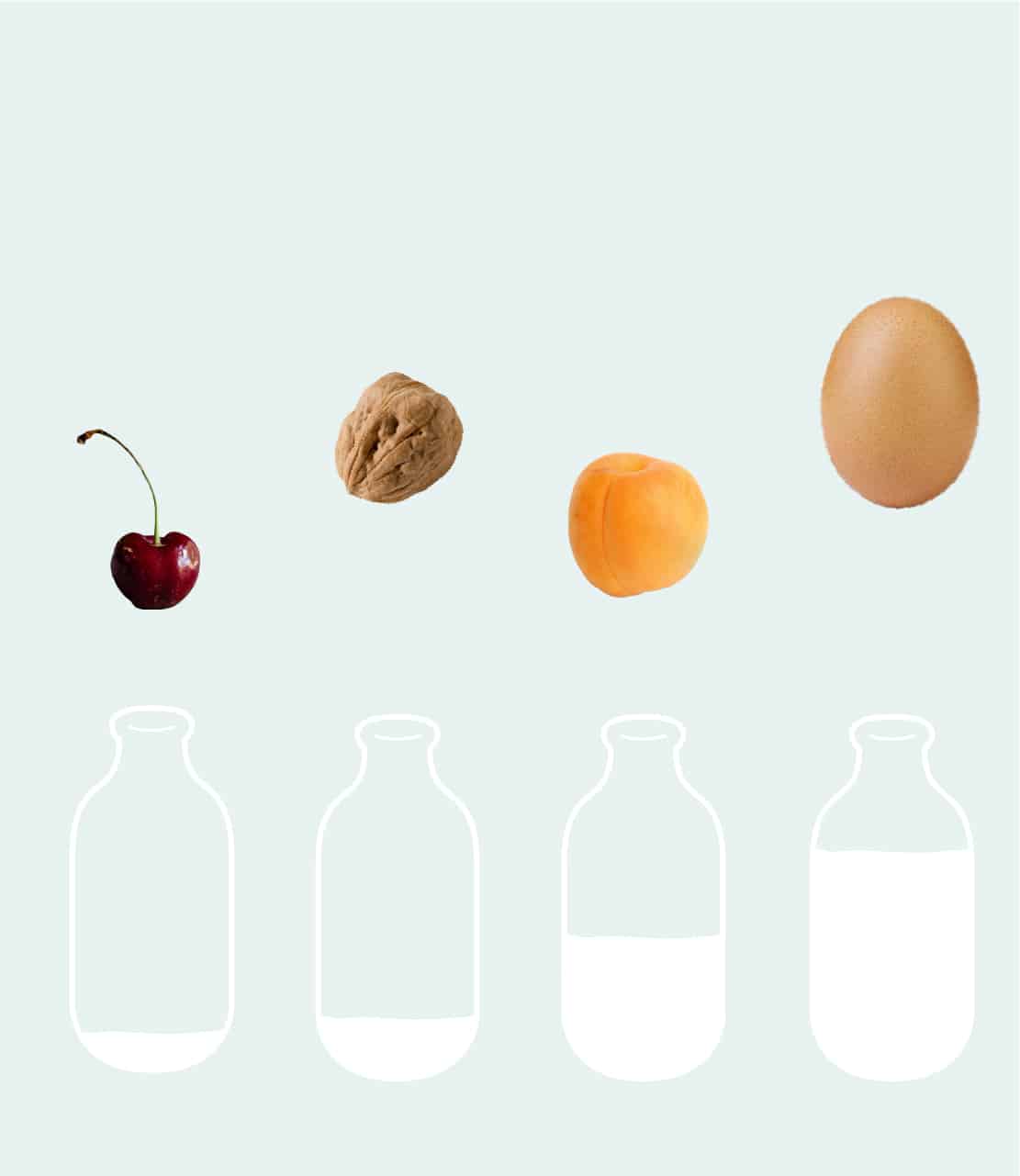
Calculate how much your baby needs to drink!
The dosage of the drinking amount for your baby is part of everyday life for you as a parent. Just one of your many new chores to take care of, not to mention dealing with acute sleep deprivation. You will quickly forget something and even everyday things will become a challenge. That's why we would like to relieve you of a task and have summarised everything for you about the dosage and drinking amount of baby formula. If you should forget something, you can keep track of the topic here and don't have to be afraid of doing something wrong.
How often do I feed my baby?
One of the first questions that will concern you as a new mother is how to calculate the right amount of milk. So, how often should I breastfeed or bottle-feed my baby, and how much milk should it drink per meal? Am I feeding my baby too much or too little milk?
For the first six months after birth, your baby will be breastfed or fed Pre infant formula. Here is the rule: regardless of whether you choose breastfeeding or bottle-feeding, the frequency and duration depend entirely on the child's needs.
Since your baby's stomach is still very small shortly after birth, an average of 8 meals in 24 hours is completely normal during the first three months.
Calculating the amount of milk based on the baby's weight during the first 3 months of life (for bottle-feeding):
1st day of life: 50-70 ml/kg per day
2nd day of life: 70-90 ml/kg per day
3rd day of life: 80-100 ml/kg per day
4th day of life: 100-120 ml/kg per day
5th day of life: 100-130 ml/kg per day
1st-3rd month of life: 160-180 ml/kg per day
The amount of milk should be approximately 160-180 ml/kg per day from the 1st to the 3rd month of life. You can also use 1/6 of your child's body weight from the 6th day of life to calculate the daily amount of milk.
Distributed over the number of meals, this means for example that at a weight of 3300 g, the daily amount of milk would be approximately 550 g (3300*1/6): distributed over 8 meals: 70 g / meal, distributed over 6 meals: 90 g / meal, and distributed over 5 meals: 110 g / meal.
The amount of milk taken can vary greatly from baby to baby: Some children want to be breastfed or fed every hour, while others are satisfied with five larger meals a day.
Note on introducing solid foods:
The introduction of solid foods should begin no earlier than the fifth month and no later than the seventh month. Your baby needs approximately five meals a day at this stage of life. Each newly introduced pureed meal now replaces a milk feeding. With approximately 8 milk feedings, this still leaves approximately three bottles of milk per day.
Calculate your baby’s fluid intake
Get Started NowHow can I tell that my baby is full?
With sufficient fluid intake (not too much and not too little), your baby should gain approx. 150-200 g per week in weight during the first half of their first year, and approx. 100 g per week during the second half. By the age of 4 to 5 months, your baby will have doubled their birth weight, and by 12 months, tripled it. It is important that their weight gain is regularly checked by a pediatrician or midwife.
But how can I tell if my baby is full or hungry?
Here are 4 signs that show you your baby is hungry:
-
it turns its head to the side to search for milk
-
it is restless and kicks its legs
-
it sucks on its own little fingers or fists
-
it smacks its lips and gulps
If the subtle signs are not noticed in time, it eventually starts to cry.
And this is how your baby shows you that it is full:
-
it slows down eating and drinking
-
it is relaxed and satisfied
-
no sucking and drinking
-
it falls asleep while nursing or drinking
-
it leaves a little milk in the bottle
Can I overfeed my baby?
Breastfeeding mothers are often afraid of overfeeding their baby with breast milk, as the amount is difficult to estimate without a bottle. But we can reassure you: it is not possible to overfeed your baby by breastfeeding. Expressed milk can also be fed according to your baby's needs. The number of bottles per day stated on the packaging is intended as a guide. Nevertheless, with bottle feeding, there is a risk of overfeeding, albeit a very small one. To prevent this, it is important to follow the preparation instructions (amount of powder, etc.) exactly. If your baby does not finish the whole bottle, that is perfectly fine; please never "force" them to drink it all. Even at this age, your baby knows how much they need and when they are full.
So you can safely trust your baby's sense of fullness!
WHO note: Breastfeeding is the best nutrition for your baby. The composition of breast milk always provides your baby with the ideal combination of nutrients and good protection against allergies and diseases. The WHO therefore recommends exclusive breastfeeding for 6 months and continuing to breastfeed after that in combination with age-appropriate and balanced complementary foods. Consult healthcare professionals (e.g., pediatrician, mother/father counseling service, midwife, lactation consultant) if your child needs supplementary food or if they cannot be breastfed (sufficiently). The use of infant formula may affect breastfeeding success.
Top 5 tips for preparing milk formula:
-
To always provide your baby with optimal care, the preparation instructions on the packaging should be followed exactly. The correct mixing ratio gives your baby exactly the nutrients it needs.
-
Please always use fresh drinking water.
-
It is particularly important to let the water cool to approx. 40-50 °C after boiling before mixing it with the milk powder. This also preserves the heat-sensitive vitamins.
-
Prepare the baby bottle fresh for each feeding. Please do not keep it warm, as germs that your baby cannot yet cope with will multiply.
-
Always close the opened package tightly, store it in a dry place and use it within 2 weeks.
Can baby formula be reheated?
It is best to prepare the baby formula fresh before each feeding and feed it to your baby right away. Leftover baby formula should not be reheated, but discarded.
Before you leave us again and give your full attention to your baby, take a look at our overview of different types of baby formula: Pre, starter and follow-on formula: Which baby formula is best from what age?
Sources:
Related Articles

Nutrition Plan for the First Year of Life
What matters when it comes to baby food and how to transition from breast or bottle feeding to complementary foods and family meals.

Changing baby milk – how, when, why?
When do you switch from initial "pre" milk to follow-on formula, i.e. to the next level? Or what do you do if your baby doesn't tolerate the current baby formula well and would like to switch?
Baby Weight – How Much Should My Baby Weigh?
We tell you about weight fluctuations and percentiles.


