Organic Baby Formula Original
 Follow-On Milk 6+
 Follow-on milk
 Organic Infant Formula from Whole Milk
 Follow-on Milk
 Organic Infant Formula from Goat's Milk
 Follow-On Milk
 Organic Bone Broth
 Beef
 For Moms
 Organic Energy Balls


Choking in Babies – An Interview with an Emergency Physician
Schon allein die ersten Schritte im Abenteuer "Elternsein" sind aufregend genug. Für frischgebackene Mamas und Papas prasseln neue Herausforderungen und Emotionen nur so auf sie ein. Doch mitten in dieser Achterbahnfahrt der Gefühle lauert auch die Angst vor dem Unerwarteten: Was passiert, wenn mein Baby einen Notfall hat? In unserem Interview mit der Notfallmedizinerin und Mutter von Zwillingen, Dr. med. Annalena Dehé, dreht sich alles um das Thema Verschlucken. Wir erklären dir kompakt , wie du an der Atmung deines Babys erkennst, ob etwas nicht stimmt und was du tun solltest, falls sich dein Baby verschluckt hat. Annalena legt dir im Interview ans Herz einen ersten Erste-Hilfe-Kurs zu machen und diesen Kurs auch regelmäßig aufzufrischen. Wir wollen dich unterstützen Lebensretter:in zu werden.
Hello Annalena, we are very happy that you have taken the time for us today. As an emergency doctor and as a married mom with twins, you certainly have a lot on your plate. In addition, you and your husband Lukas founded “12minutes” together and train mothers and fathers online on the topic of first aid for babies. Let's get straight to the questions.
Why did you call your baby first aid course "12minutes"?
I’d be delighted! Thank you very much for having me here today.
In Germany, it takes an average of 12 minutes for emergency services to arrive on the scene. Of course, especially in the city, it can sometimes be shorter, but in rural areas, it can also take longer. We gave our course this name because we want to help parents make the best possible use of those terribly long minutes.

What does normal breathing look like in babies during the first and later months of life?
During the first few months of life, babies normally breathe mainly through their noses. Only over time—at around three to four months of age—do infants develop the ability to also breathe through their mouths. In newborns, the normal breathing rate is between 35 and 45 breaths per minute. In infants from 6 to 12 months, the breathing rate begins to approach that of older children. The breathing pattern also becomes more regular. The breathing rate then usually ranges between 20 and 30 breaths per minute.
And how can you tell from a baby’s breathing that something is wrong?
There are four factors that may indicate to parents that something is wrong with breathing:
- Bluish discoloration of the skin or lips and fingernails (cyanosis): This can be a sign of insufficient oxygen supply.
- Altered breathing rate: Count the baby's breaths per minute. Normally, the breathing rate should be between 35 and 45 breaths per minute. A breathing rate that is too slow or too fast over an extended period can be a warning sign.
- Altered movements of the chest and accessory respiratory muscles: Check whether the baby's nostrils move with each inhalation and whether the transition between the neck and chest sinks. Is the breathing even on both sides?
- Noticeable additional sounds: Listen for possible sounds such as squeaking, rattling, humming, or whistling. These can be a sign of bronchitis with narrowed airways.
What immediate actions should be taken in case of unusual breathing patterns?
Unfortunately, there are no effective immediate measures for all respiratory illnesses or breathing patterns. In the case of so-called croup, a viral infection that often presents with a severe barking cough, breathing difficulties can be alleviated by cold, moist air – for example, by standing in front of an open refrigerator door.
The most important thing is to recognize the unusual breathing pattern and call emergency services early.
We also repeatedly find that it is extremely important to keep oxygen consumption as low as possible, and panic immediately leads to a stress response with increased oxygen demand. This is why it is so important – although unfortunately difficult for parents – to remain calm and soothe the baby in such a situation.
What are the choking hazards for babies?
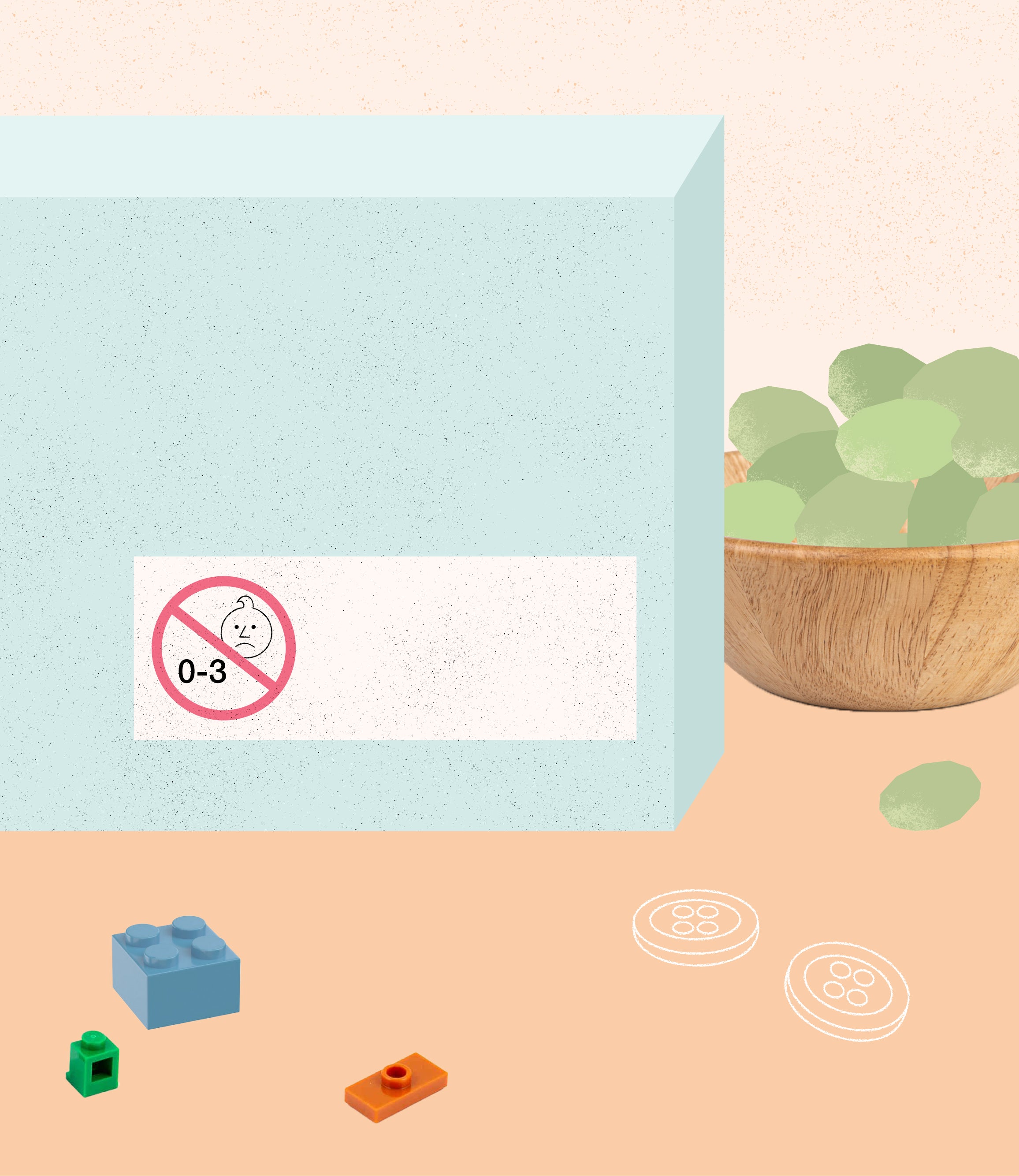
The greatest danger is choking, which occurs when an infant or even a young child accidentally inhales an object. This includes small toy parts, needles, marbles, buttons, coins, or pieces of food such as grapes, blueberries, slices of sausage, or cocktail tomatoes.
Depending on its consistency and shape, the foreign object can partially or completely block the trachea or main bronchi, so that little to no air can flow through the trachea into the lungs. This is an absolute emergency.
What should I do if my baby has choked?
First, parents should check whether the foreign object is still in the mouth. That is, take a look inside the open mouth. Important: Do not, under any circumstances, search the back of the throat for foreign objects.
If the baby is coughing effectively, wait and see, because nothing is as good as an effective cough. However, you can help a little by gently leaning the baby forward.
The opposite of an effective cough is an ineffective cough. Ineffective means that the foreign object is not dislodged, the cough becomes quieter, and the baby cannot catch its breath properly between coughs.
As soon as the cough becomes ineffective, parents should act immediately and also call emergency medical services.
- Parents should immediately place their baby face down on their forearm or thigh. The upper body should be angled forward. It is important to hold the angle of the jaw with one hand so that the baby's head does not jerk from front to back during the maneuver.
- In this position, up to 5 firm blows should be delivered to the middle of the back.
- If the object does not fall visibly out of the mouth, parents should repeatedly check to see whether it has moved back up into the mouth.
- If so, it can be removed with two fingers. If the 5 blows to the back had no effect, 5 chest compressions should then be performed with the baby lying head-down. These maneuvers should be continued until the foreign object is dislodged or emergency services arrive.

What are some common mistakes parents instinctively make when their child chokes?
As mentioned, many parents reflexively reach directly into the child's mouth. Looking into the mouth for a foreign object and gently removing it is correct. But parents should under no circumstances feel around for foreign objects deep in the throat that they cannot see. This would push the pieces further into the throat and worsen the situation.
Another mistake that parents often make is applying the Heimlich maneuver to children under one year of age because they know it from adult first aid. For several reasons, this is not suitable for infants. On the one hand, the neck muscles are not sufficiently developed at this age, and the head would be tossed back and forth during the maneuver. On the other hand, the maneuver can cause damage—such as internal bleeding—to organs that are still developing.
How can the risk of choking be avoided?
As a preventive measure, all potential hazards should be eliminated, i.e. babies should only play with suitable toys and small objects should always be stored out of reach. This is where the difficulty lies when there is already an older sibling living in the household.
As a simple rule of thumb, you can remember: Anything that fits through the closed thumb and forefinger (of an adult hand) is not suitable for a toddler to play with.
The other danger is choking in the sense of inhaling food. Here, especially with the introduction of complementary foods, one should ensure that food is introduced safely, i.e. raw food should be steamed at the beginning, nuts should initially be offered in the form of nut butter, and firm and smooth berries or tomatoes should be cut into four pieces.
When it comes to food and safety, there are of course many other tips, e.g. regarding the choice of the high chair. Here, it makes sense to choose a high chair with a footrest. This makes the seat more stable, which helps during eating itself, but also in the event of choking, because the cough will be stronger and the foreign body can be coughed out more effectively.

Are choking hazards also a cause of sudden infant death?
Sudden infant death is often associated with many different causes, which fortunately are increasingly well understood. Safe sleep for babies has worried many parents from day one, and as a result, the incidence of sudden infant death has been significantly reduced since the 1980s.
What parents should know: The sleep environment significantly affects your baby's breathing. To create a safe sleep environment for your baby, a few recommendations should be followed:
- Sleeping on their back in their own cot in the parents' bedroom on a firm sleep surface.
- A room temperature of around 18–20 degrees Celsius in the bedroom and the use of a baby sleeping bag.
- A smoke-free bedroom, or preferably all rooms in households with children.
- A well-ventilated sleep area to ensure healthy air for breathing.
Why is it so important for new parents to take a first aid course?
Being a parent, especially a new parent, is exciting enough! Emergencies happen, you can't foresee every eventuality, and besides, 60% of all emergencies involving children happen at home, and parents are often left to fend for themselves at first.
To be able to help in the best possible way in emergency situations, it is best if all parents and all people involved in the care of babies and children are trained in first aid. But it is not only important to have completed a first aid course, because only those who regularly practice and review are then able to recall and correctly apply the measures in an emergency.
With "12minutes", we hope to further "demystify" the topic of first aid and turn many more parents into lifesavers.
Thank you very much, Annalena, for the really exciting conversation!
Dr. med. Annalena Dehé

Annalena is a specialist in internal medicine and emergency medicine, and also holds additional certification in basic nutritional medicine. She is the mother of twin girls and founded "12minutes" in 2022 with her husband, Dr. med. Lukas Dehé, who is also a specialist and emergency physician.
12 minutes
12minutes is an innovative online first aid course. What makes it special: each participant receives their own infant-sized practice doll to regularly practice and review first aid measures. Why 12 minutes? That is the average time it takes for emergency services to arrive in an emergency, meaning the time parents are on their own. Annalena and Lukas founded 12minutes so that parents can make the most of this time until emergency services arrive. You can find more information and the link to the course at 12minutes.de.
Read on ...
Discover more of our Expert Interviews.
Related Articles

Calculate how much your baby needs to drink!
How do you know your baby has had enough? Is it possible to overfeed or underfeed your baby? How to calculate how much your baby is drinking...

Nutrition Plan for the First Year of Life
What matters when it comes to baby food and how to transition from breast or bottle feeding to complementary foods and family meals.
Mom Burnout – another taboo topic
Care work is also work, and that's why it's not uncommon for mothers to suffer from burnout...