


 Organic Baby Formula Original
 Follow-On Milk 6+
 Follow-on milk
 Organic Infant Formula from Whole Milk
 Follow-on Milk
 Organic Infant Formula from Goat's Milk
 Follow-On Milk
 Organic Bone Broth
 Beef
 For Moms
 Organic Energy Balls
 for nursing mothers


Fats – Why are they so important for baby's development?
When you think of the word "fat," you might picture fried fries or pizza with lots of cheese. But why are fats so important for babies? Not all fats are the same. You may already know that there are good and less good fats, and that the good ones are indispensable for the body. Why do fats play such a crucial role specifically for babies' development, and how do the fats in human and animal milk differ? This article covers all of these questions about fats for babies in detail.
These are the questions we will answer in this article:
- Why do babies need fat?
- What fat sources are available for follow-on baby milk?
- What are fats?
- What do animal fats have that plant-based fats do not?
- Which fats are missing from cow's milk compared to breast milk?
- Conclusion: Which fats are important for follow-on baby milk
Why do babies need fat?
Fats are important in a baby's diet because they provide energy. During the first six months of life, fats account for about half of the energy in breast milk. So, along with carbohydrates, fats are an important source of energy for babies.
Fats also help the body better absorb fat-soluble vitamins such as A, D, E, and K.
But fats do even more! They support your baby's healthy growth and influence brain development, the body's immune defenses, and the regulation of inflammation.
That is exactly why it is also important to add sources of fat to follow-on baby milk.
What fat sources are available for follow-on baby formula?
For breastfed babies, the important fats for their development come from breast milk. If exclusive breastfeeding is not possible or desired, it is possible to feed a special follow-on milk formula from the 6th month. This is produced in such a way that it mimics the fat content and the type of fats (i.e. the fatty acid composition) in breast milk.
Fat sources for follow-on baby milk are plant-based fats and animal-based fats. Plant-based fats and oils are obtained from various parts of plants, such as seeds or kernels. There are tropical oils such as palm oil or coconut oil, as well as domestic oils such as sunflower oil, rapeseed oil, and linseed oil. Animal-based fats are found in the milk of mammals such as cows or goats.
Are animal-based fats or plant-based fats actually better for babies? Before we address this question, let's first address the question of what fats actually are.
What are fats?
Broadly speaking, fats consist of various fatty acids. Three groups of fatty acids can be distinguished here: saturated fatty acids, unsaturated fatty acids, and trans fatty acids.
Saturated fatty acids
Saturated fatty acids are fatty acids that are so to speak packed or saturated. Because chemically speaking all carbon atoms are completely linked with hydrogen atoms by single bonds. They are found in animal products such as meat, butter and cheese as well as in some plant oils such as coconut oil and palm oil.
IMPORTANT: An important saturated fatty acid for a baby's nutrition is palmitic acid. The total fat content in breast milk consists of approx. 25% palmitic acid.
Unsaturated fatty acids
Unsaturated fatty acids have something special: double bond(s) in their linkages. Depending on how many of these double bonds are present in a fatty acid, a distinction is made between monounsaturated fatty acids (one double bond) and polyunsaturated fatty acids (two or more double bonds).
IMPORTANT: Linoleic acid, an omega-6 fatty acid, and 𝛂-linolenic acid (ALA), an essential omega-3 fatty acid, are among the polyunsaturated fatty acids.
Linoleic acid and ɑ-linolenic acid (ALA) are precursors of arachidonic acid (ARA) as well as docosahexaenoic acid (DHA) and eicosapentaenoic acid (EPA) – all important fatty acids for follow-on baby milk!
Trans fats
Trans fatty acids are formed in two ways. Firstly, during the production of certain fat and oil products, especially in highly processed foods such as chips or fried food. These trans fatty acids increase bad cholesterol in the blood and are unhealthy. However, they also occur in very small amounts in some natural foods such as milk, where they are produced by tiny organisms in the animals' stomachs. Natural trans fatty acids are also significantly less harmful than artificially produced variants.
WHO note: Breastfeeding is the best nutrition for your baby. The composition of breast milk always provides your baby with the ideal combination of nutrients and good protection against allergies and diseases. The WHO therefore recommends exclusive breastfeeding for 6 months and continuing to breastfeed after that in combination with age-appropriate and balanced complementary foods. Consult healthcare professionals (e.g., pediatrician, mother/father counseling service, midwife, lactation consultant) if your child needs supplementary food or if you cannot (sufficiently) breastfeed. The use of infant formula may affect breastfeeding success.
In a nutshell
Fats are not all the same. They differ in their structure and the types of fatty acids they contain. Saturated and unsaturated fatty acids are important for the age-appropriate development of babies.
What do animal fats have that vegetable fats do not?
To answer this question precisely, we look at three aspects: the number of fatty acids, the position of palmitic acid in the chemical structure, and the milk fat globule membrane (MFGM). Don't worry, it's super easy to understand.
The number of fatty acids is greater
Animal fats have a greater variety of fatty acids than plant-based fats. Breast milk contains around 200 different fatty acids, while cow's milk contains around 400 different fatty acids. In comparison, plant-based fats contain significantly fewer different fatty acids.
Animal fats thus offer a broader range of fatty acid building blocks compared to plant-based milk. This increases the variety of nutrients in Follow-Baby milk and can support babies' growth and development.
Correct position of palmitic acid in the fat molecule
Another important difference concerns the position of palmitic acid in the fat molecule. You can think of a fat molecule as a kind of chain of chemical compounds. In breast milk, a specific fatty acid called palmitic acid is located mainly at a specific place in this chain, called the "sn-2 position". It is as if something is hanging on a special hook.
In breast milk, this is the case for more than 60% of the palmitic acid. In cow's milk, about 40-45% of the palmitic acid hangs on this special hook, the "sn-2 position". But in plant fats, this is only the case for about 10-20%.
Why is this important? Because the way palmitic acid is positioned in the fats affects how our body digests and uses these fats. Fatty acids in the "sn-2" position enable better calcium absorption and can have a positive effect on bone density, while constipation and hard stools are avoided.
Milk fat globule membrane (MFGM) only in animal fats
The milk fat globule membrane (MFGM) is only found in animal fats. This membrane consists, among other things, of proteins and coats the fat droplets in milk. MFGM is produced exclusively by mammals, including humans, and is absent in plant-based fats.
Recent studies also suggest that follow-on baby formula enriched with MFGM may have a positive effect on gut health, the composition of the microbiome, as well as on the development of the brain and immune system.
Animal fats have several advantages over plant-based fats.
|
Interesting to know: On the German market, follow-on baby milk is based almost exclusively on skimmed milk. That is, milk from which all milk fat has been removed. For this reason, fats, almost exclusively plant fats, must be added back in afterwards. Why? Here, the price of whole milk powder compared to skimmed milk powder plays the decisive role. |
Which fats are missing from cow's milk compared to breast milk?
Humans are mammals, just like cows and goats. The fat content of human and animal milk is similar, at around 3.4 to 4.0 g per 100 ml. Palmitic acid, a non-essential fatty acid, is also similar in both and makes up about 25% of the fatty acids.
However, they differ in their essential fatty acids. Breast milk contains more essential fatty acids.
For this reason, essential fatty acids such as omega-3 and omega-6 fatty acids are added to cow's milk-based baby formula using vegetable oils. Palmitic acid, and therefore a tropical oil such as palm oil, does not need to be added.
Conclusion: Which fats are now the best for baby formula?
Fats are important for babies because they provide energy and promote the absorption of fat-soluble vitamins. In addition, fats support healthy growth, brain development, immune defenses, and inflammation regulation.
Animal-based milk fats can collectively promote the growth and development of babies because they offer the following advantages over plant-based fats:
- they contain a greater number of fatty acids
- palmitic acid is in the ideal position, the "sn-2 position," in the milk fat globule
- milk fat globule membranes (MFGM) are included
Whole cow's or goat's milk is ideal for baby formula because of its fat content.
Why then do many manufacturers use skimmed milk instead of whole milk? Price often plays the decisive role here. Whole milk is more expensive than skimmed milk.
Baby formula based on skimmed milk with exclusively added plant-based fats is suitable for babies. Baby formula based on whole milk with far fewer added plant-based fats is even better suited to babies' needs.
Sources:
Vanderhout, S.M., Birken, C.S., et al. (2016) Relation between milk-fat percentage, vitamin D, and BMI z score in early childhood. The American Journal of Clinical Nutrition. Available at: https://pubmed.ncbi.nlm.nih.gov/27852618/
Vanderhout, S.M., Aglipy, Mary, et al. (2020) Whole milk compared with reduced-fat milk and childhood overweight: a systematic review and meta-analysis. The American Journal of Clinical Nutrition. Available at: https://www.sciencedirect.com/science/article/pii/S0002916522010036?via%3Dihub
Related Articles

Drawing from the best: Milk formula from whole milk
Finally available on the German market: infant formula made from whole milk powder. Learn more about why we are so excited.
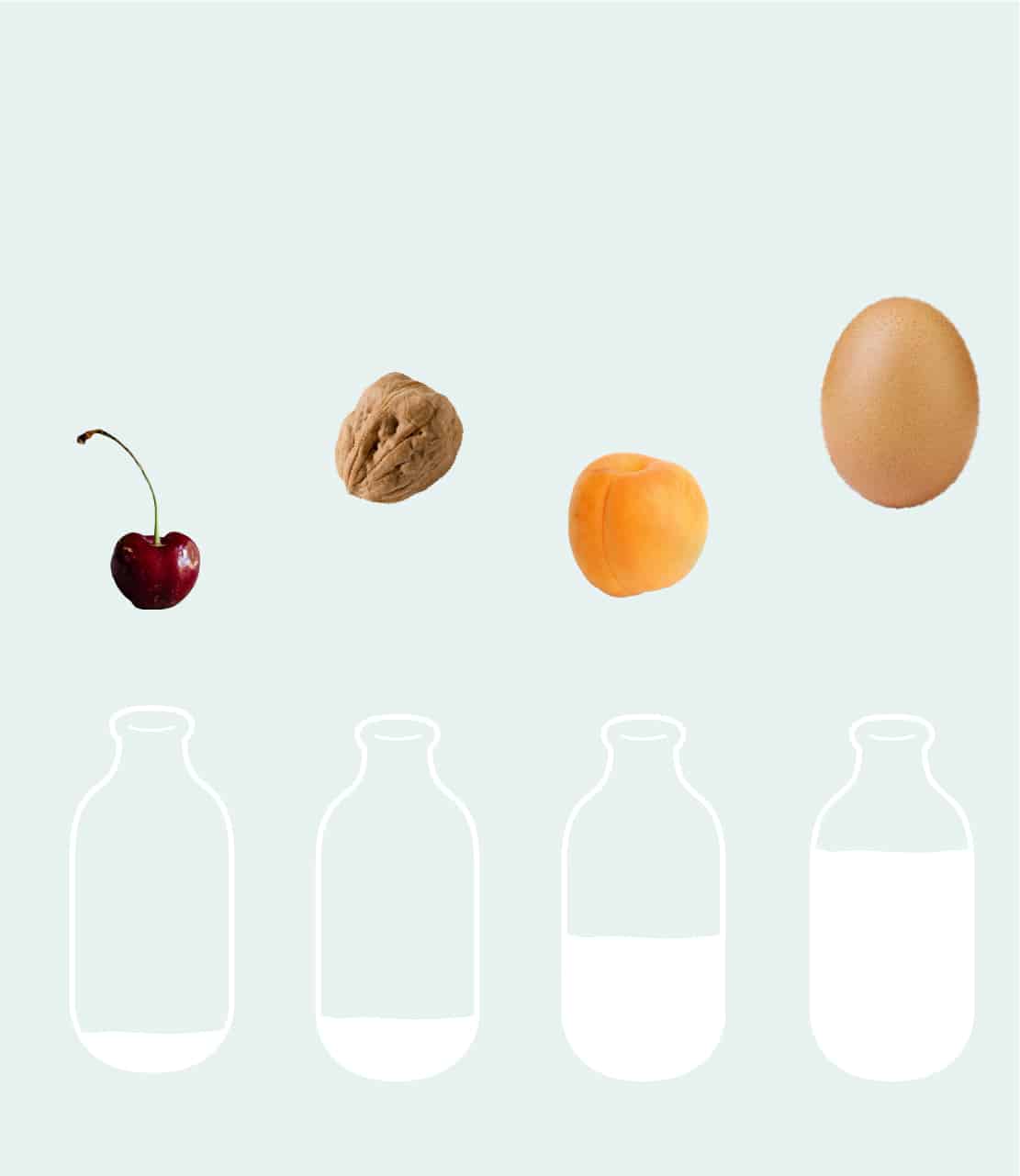
Calculate how much your baby needs to drink!
How do you know your baby has had enough? Is it possible to overfeed or underfeed your baby? How to calculate how much your baby is drinking...

Our baby milk is the test winner at Stiftung Warentest
We are test winners at Stiftung Warentest: Our "Pre" First infant Formula based on cow's milk (skimmed milk powder) received the best rating.


