Organic Baby Formula Original
 Follow-On Milk 6+
 Follow-on milk
 Organic Infant Formula from Whole Milk
 Follow-on Milk
 Organic Infant Formula from Goat's Milk
 Follow-On Milk
 Organic Bone Broth
 Beef
 For Moms
 Organic Energy Balls


Healing Birth Injuries: Perineal Tears and More
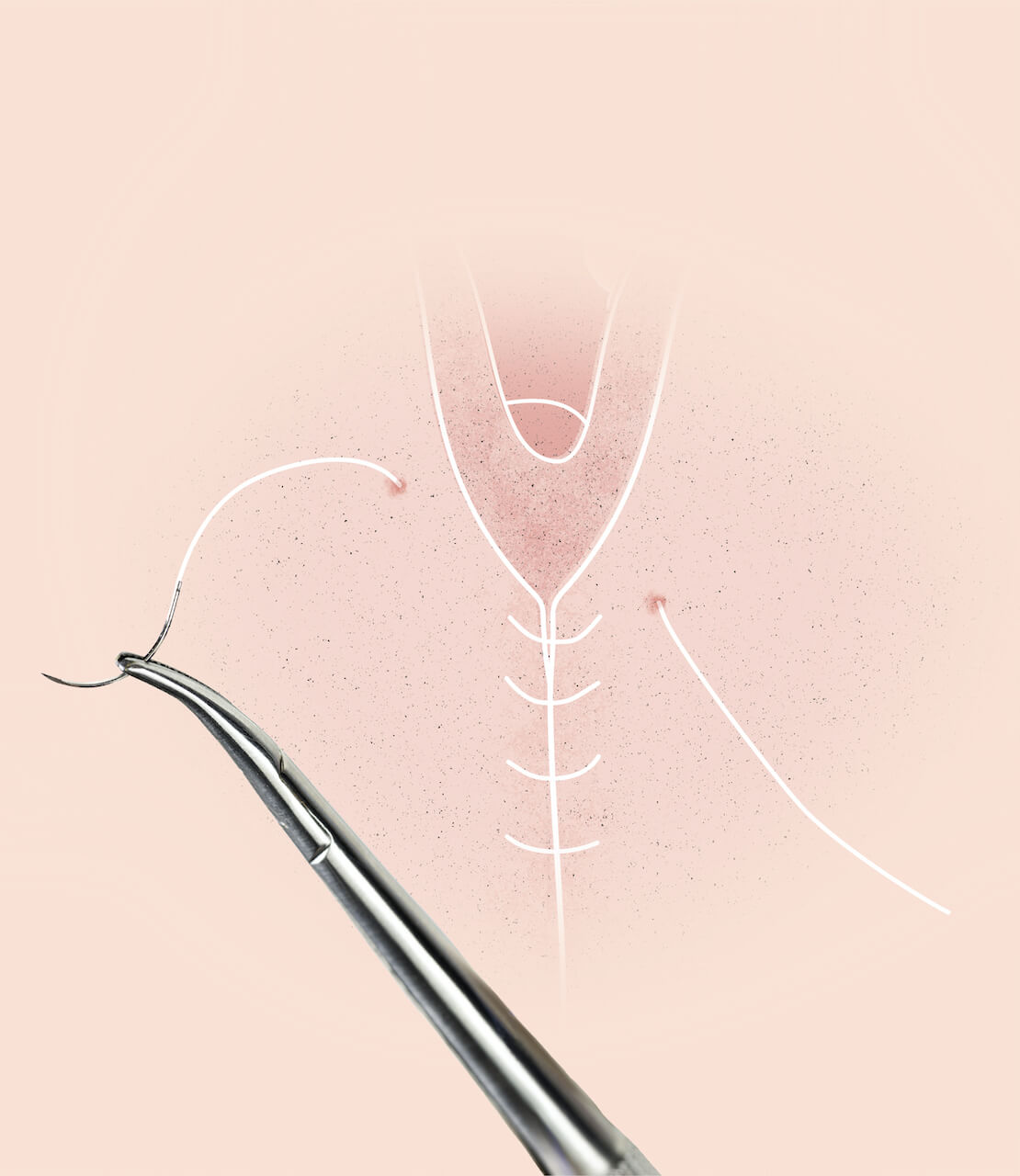
Perineal tears, vaginal tears, minor abrasions on the labia – birth injuries happen, period. After all, childbirth is anything but easy. Although not every woman suffers injuries during a vaginal birth, there are more than enough who do. Yet the subject remains taboo – which is almost understandable. After all, one’s partially lacerated genitals aren’t exactly something people are eager to talk about in large groups. Still, we believe: Let’s talk about our vaginas – and our labia, perineal areas, and so on!
[%%% article-gehort-nun-mal-dazu-1 %%%]
|
Note 1: Here we are only talking about the physical injuries that can occur during a vaginal birth – a cesarean section is, of course, a completely separate issue in itself, involving its own injury from which the body must first heal. A C-section is, after all, a major surgical procedure, yet mothers are usually expected to be back in top shape in record time afterwards – why this is problematic is obvious. |
|
Note 2: Although the topic did not come up in the interview, we would like to add that there are experts in pelvic floor physiotherapy. From the first trimester until after the birth of your child, these experts can support you. It is never too early or too late to start pelvic floor exercises. |
A birth injury is a rather intimate matter. Just as childbirth is a rather intimate matter, no question about that! And because every birth is different, we thought we'd ask a woman who really knows her stuff – and has truly seen just about everything.
In conversation with midwife Christiane Hammerl from Berlin.
Why birth injuries are sometimes unavoidable – on healing and prevention
How wonderful that you have time for us today, dear Christiane! You work as a freelance midwife in Berlin and are also a birth attendant. So for years you have been supporting women with one-on-one care during childbirth, prenatal care, and the postpartum period. Thank you that we can talk about the topic of birth injuries today!
What types of birth injuries are there, actually, and why do they occur?
Due to the immense force exerted on the body, especially during the pushing stage, minor and even more significant injuries in the intimate area can occur. Perineal tears, i.e., injuries between the vagina and anus, can occur if the baby's head is slightly larger than the vagina can stretch. More rarely, vaginal tears, minor abrasions to the labia, or very rarely even abrasions to the clitoris can also occur.
Generally, however, these are all external injuries that heal quite quickly (especially in mucous membranes). So, first of all: don't panic about a possible birth injury!
An episiotomy is certainly the most common birth injury there is. What exactly happens?
There are different types of perineal tears, classified as first-, second-, third-, or even fourth-degree tears.
In a first-degree perineal tear, only a small area of skin is torn, while in a second-degree tear, the superficial muscles are also torn. A third-degree tear is more severe, as the anal sphincter is also torn—either partially or completely. This is already quite rare, and a fourth-degree tear is even more so, as the bowel mucosa is also torn.
However, the mildest injuries—first- and second-degree tears—are the most common and do not cause major problems.
How long does it take for a torn dam to heal?
Of course, this depends on the severity of the injury – a minor abrasion heals quickly, while a tear in the perineum usually heals within a few days to a maximum of a few weeks. An episiotomy, for example, where the perineal area has been surgically cut, heals a little more slowly.
But no matter whether you have a minor or major injury – or none at all: What is really important is to rest during the postpartum period.
Of course, as time goes on, you can walk around the house a bit more and later go for walks, but I advise all women to stay in bed for the first 10–14 days and really recover – and not try to do the weekly shopping by yourself as early as day three.
That is why it is very important to seek support, and above all, to accept it! Whether it is from friends and family, or simply delivery services and the like. Because of course, it is difficult to generalize completely – in some families, the father may not be able to take 100% time off during the postpartum period, or the family simply lives too far away to really help. For exactly these families, delivery services are simply a huge help.
What is also naturally extremely important for the healing of birth injuries, and in general: Take good care of yourself!!
How is the best way to care for the dam-seam?
Tampons should be changed regularly, and after using the toilet, the labia should be rinsed with cool or lukewarm water – for example, with a spritz of calendula essence to support the healing effect.
The Happy Po, for example, is quite suitable for this, or you can simply take an old little jug, glass, or even a water bottle that you might not have used anyway. I’m also a big fan of being practical – sure, you can spend an extra €20 on a peri bottle, and of course the shape is optimized, but ultimately it also applies: Why not just think and use something you already have?
What is most important when healing from a perineal tear, and which remedies really work?
I always recommend calendula essence for douching or also for applying it directly diluted to the pads. The sitz bath by Ingeborg Stadelmann too – incredibly soothing and that also supports the healing effect.
“My personal favorite tip: Let the wounds breathe!! ”
Christiane Hammerl
Being in disposable plastic briefs all day is simply not ideal for wound healing. That's why I always recommend lying completely naked on the bed two or three times a day—with a towel or changing pad underneath—and just letting the wound get a little fresh air. It might feel strange for a moment, but it simply heals better.
What if it still hasn't healed properly months later?
This can actually happen – because some women simply have very sensitive skin or also react poorly to the suture material. So if you still don't feel completely comfortable with it days or even weeks later: it is okay to bring it up! Ideally, of course, the midwife can take a look at it during the postpartum period.
You can also always contact the gynecologists who treated you or the clinic where you gave birth about these concerns. In the absolute worst-case scenario, you can even have the sutures revised – but that really happens very rarely.
Very, very rarely, but still possible, of course: allergic reactions to the suture material. In that case, you cannot immediately stitch it back up because the postpartum bleeding is still flowing, so complete bed rest is really necessary!
Important: Just because a birth injury does not heal well or you might react to the sutures, it by no means means that it has to stay that way forever. A lot of things can still be changed afterwards – so if you feel increasingly uncomfortable with your injury after birth, you don't just have to put up with it.
Episiotomy – Why is this procedure performed during childbirth at all, and what are the advantages and disadvantages?
Episiotomies used to be standard practice – whether that was simply because no one knew any better or because people genuinely believed they were necessary and made childbirth easier for women, I can't say. Perhaps it was also because there were naturally far more men in delivery rooms back then!
Over time, the practice has been somewhat phased out – of course episiotomies still happen, and I have to perform them occasionally too, but there really has to be a medical reason. For example, if it is highly predictable that a major tear will occur without intervention, or if the baby's heart sounds are alarmingly poor and the baby needs to be delivered within 1–2 contractions.
How can birth injuries be avoided?
It is very important, and therefore also preventive, to have a trusted person by your side. A midwife who attends you throughout pregnancy and birth would be that person; for example, I know that I have a very low rate of birth injuries among my patients. Because when that trust is there, you can simply work together wonderfully. But even in the event that you cannot find a midwife who attends you throughout pregnancy and birth, having a trusted person in the delivery room is simply great – it provides reassurance, and this person can clearly communicate your wishes and preferences. Even when you are no longer able to do so yourself.
As a preventive measure during pregnancy, I also always think it is great when women can develop an awareness of their bodies – whether that be Pilates, yoga, or simply conscious breathing. This simply builds self-confidence in your own body, and that is, of course, also an important point on a psychological level.
Exactly the same applies to familiarizing yourself with the topic of birth injuries before giving birth, because this can be incredibly helpful in avoiding fear of them. After all, fear achieves nothing.
A perineal massage in preparation for birth from around the 34th week of pregnancy is also always a great option to prevent birth injuries. I really like using Weleda's perineal massage oil for this, but steam baths beforehand or warm compresses on the perineal area can also help to prepare it.
Do you have a few final tips? Do you know of any interesting books, blogs, or Instagram accounts that explore this topic?
I always love recommending “Guter Hoffnung” by Kareen Dannhauer—it really is a standard work. I also think the podcast “Die Friedliche Geburt” is absolutely wonderful.
This isn’t a book recommendation, but it is incredibly important nonetheless: positive conversations about childbirth. No one should go into childbirth feeling afraid, which is why I also started my own podcast, Hebamme Berlin, where I talk with women about their childbirth experiences.
As a midwife, I always tell my patients that, as an expert in pregnancy, childbirth, and the postpartum period, I am responsible for their health. That is why I always love saying: Congratulations, you are pregnant, you are healthy—and now I’ll take care of you!
Thank you so much for the wonderful conversation, dear Christiane!
About Christiane

Christiane Hammerl is a self-employed midwife in Berlin. She assists with attended births at the Klinikum Vivantes Friedrichshain. As a midwife, she also supports young families during pregnancy and the postpartum period. Her focus is on one-to-one birth support. You can find Christiane on Instagram: @Hebamme_Christiane and @Hebammenzimmer.berlin.
Our tip: Postpartum soup
For all new mothers who feel particularly weakened after the birth of their little miracle, a hearty broth is a wonderful way to replenish energy reserves. With selected ingredients, the soup helps you feel strengthened again. Learn more about the postpartum soup.
Helpful links:
Hebammenzimmer – Christiane's practice: https://hebammenzimmer.de/
Christiane's Instagram https://www.instagram.com/hebamme_christiane/
Weleda oil: https://www.weleda.de/produkt/d/damm-massageoel
Calendula essence: https://www.weleda.de/produkt/w/weleda-calendula-essenz
Stadelmann sitz bath: https://www.milchwiese.de/ingeborg-stadelmann-sitzbad-100ml (all also available at the pharmacy)
Happy Po: https://happypo.de/
Related Articles

Into the cup: Postpartum soup and soup for mom's (to be)
Postpartum soup strengthens the body of new mothers and replenishes energy reserves.

Postpartum depression – treatable yet still a taboo subject
Heads up! Far too often, women slide into postpartum depression after birth.

Experts share their knowledge in inspiring conversations, thoroughly researched and to the point.